Wednesday, December 1, 2010

UL Rain Kilt


Zpacks (http://www.zpacks.com/) was really one of the first cottage manufacturers to use cuben fiber. In fact, owner Joe Valesko uses it nearly exclusively and his own backpacking endeavors proved its long-term staying power in the lightweight backpacking industry. When I really want to test how light I can go, I bring along one of his Blast packs and Hexamid Duo tents. Both are so absurdly light that it's nearly comical.


As I've mentioned before, I usually bring a ULA-Equipment Rain Wrap with me for my lower body. To me, it's a multi-use item as it not only keeps my lower body relatively dry, but it is a nice extra piece of sylnylon which I've used as a ground cloth, quilt protector, pillow, and vanity cover when bathing or doing laundry on the trail. I've also rigged it to my Hexamid to serve as a door in severe weather.


Zpacks has decided to make this already great idea a little better by making it out of cuben. The TrailLite Designs Cloud Kilt for $55 is a mere 1.6 oz and is essentially the same product. I've asked Joe to see if he can tinker with the design a bit to make it a dual-use item specifically designed as doors for his Hexamid line.


Now before you start saying a kilt isn't for you, think about it long and hard. Aside from the multi-use aspects which a pair of rain pants just can't offer, a skirt/kilt is easier to put on, offers better ventilation, is lighter, and really keeps the vital stuff dry. As one poster mentioned when talking about gaiters, few seem to care whether their shins or ankles are dry.

Wednesday, November 24, 2010

Nano Striker


One of the great things about blogging is the collaborative environment it inherently creates as people openly share their knowledge. Backpacking further brings with it a community which shares an unspoken bond of good naturedness and apathy which I've long appreciated.


In a recent blog I talked about a new flint striker that I wasn't thrilled with and one of our readers (Thanks Basti!) brought to my attention another great video by Jason Klass (http://www.geartalkwithjasonklass.com/2009/12/exotac-nano-striker.html) in reference to a product by Exotac known as the Nano Striker.


The Nano Striker is a ferrocerium rod encased in aluminum (or titanium if you have the money). Why is this useful? Well, I carry my flint striker around my neck and the sweat from my chest has degraded it substantially. Rather than have it clanking around outside of my shirt and getting caught on branches, the Nano Stricker is a nearly ideal solution for my needs because it keeps it dry. Course, Jason and his readers figured this out a year ago when he posted his video. SORRY, I missed it!


The Nano Striker is $27 ($75 for titanium) and comes in at 14.5 grams. I like the fact that it comes in multiple colors depending on whether you need it to be obnoxious or not. For example, mine is blaze orange as keeping it highly visible while backpacking is important to me.


The unique aspect of the Nano Striker is that the user essentially unscrews it to gain access to the ferrocerium rod and striker. One end is screwed to the rod side to make the handle longer which overall creates a very nice system. The striker itself is very short, but very sharp and can even be further sharpened if necessary. It claims to last for about 1,000 strikes. The aluminum is aircraft grade and little rubber rings help ensure the contents remain dry. It comes with a lanyard and extra rubber ring in addition to a nice little box and instructions.


Wednesday, November 17, 2010

Lightweight Compass


A compass is one of those pieces of gear that is critically vital in an environment where getting lost is a reality. Talking about compasses could be quite a lengthy and in depth conversation - one which you won't find here as others have covered it far more effectively.


Oddly enough, a compass is only somewhat useful in the areas I hike due to the extensive tree canopy and lack of observable land features. As a result, I have absolutely no need for a high-dollar compass capable of not only telling me direction, but making me breakfast.


With that said though, that doesn't mean I'd ever leave a compass at home. For example, the Appalachian Trail is a north/south trail. A running joke of AT thru-hikers when getting up in the morning is the silly question of "what direction are you heading today" as the choice is painfully obvious. Still many get lost on the AT and surrounding trails, not because the trail isn't well marked, but because side trails often aren't as well marked and trips into the woods quickly help any sign of a trail or direction disappear.


For as well marked as the AT is, I've honestly almost gotten lost several times. These situations have all occurred after a trip into a densely forested area to look for water, a bathroom area, or a stealth area to set up camp. Unless the ground is perfectly level, which it rarely is, I can walk a couple dozen feet into the forest only to turn around and find that the trail is completely gone from my perspective. Trust me when I say not immediately seeing the trail is unsettling.


To ensure I'm not the next SAR rescuee paraded around on a local newspaper, I generally do two things to ensure my direction. First, and something that works well on the AT, I take a quick look at a button compass I carry and ensure I fully appreciate the direction I'm heading. When I get to where I'm going, especially if I'm staying the night, I often arrange some sticks or stones to point me in the direction out. This may be vital if needing to make a quick escape in the middle of the night from any number of potential issues.


Although some may genuinely need a full-scale compass, a button compass is something I have found to be ideal for my needs. It is smaller than a penny, weighs virtually nothing, and is quite accurate. I like the Mini Tracker Survival Buttom Compass from Best Glide Aviation Survival Equipment (http://www.bestglide.com/). It is a NATO approved liquid-filled compass also endorsed by the Boy Scouts of America. It comes in a 14mm and 20mm size and functions from -20f to 120f and is water resistant to 30 ft. At less than $3, it's one of those pieces of gear which really should never be left home. I carry it regardless even though my Suunto Core watch has a compass built into it, which as I learned about a month after purchasing the watch, the digital compass can be quite wrong.


I always carry a whistle around my neck and I found that adding a button compass to it with some Super Glue makes the compass perfectly available, out of the way, and handy - plenty easy for a quick glance without fumbling through my pack or pocket. On a side note, Super Glue is amazing stuff. Although I usually purchase several button compasses at a time, I recently tried to get one of the compasses off a whistle to relocate it to something else. Bottom line - it wasn't moving, so feel plenty confident in a little glue.


Wednesday, November 10, 2010

Meet the Exped SynMat 7 UL - Rival to the NeoAir


In July 2010 at an Outdoor Show in Germany, Exped (http://www.exped.com/) revealed a sleeping pad which would easily compete with the famed NeoAir. Personally, I wasn't a big fan of the NeoAir for many reasons, but it does have a following. More correctly, people either love it or hate it and one could probably read between the lines a bit when it was announced that Thermarest was redesigning the NeoAir for the coming future.


The Exped SynMat 7 UL in an insulated sleeping mat which weighs just 16.57 ounces (470 grams) for a rectangular 72.04"x 19.68" (183x50cm) and an intriguing R-value of 3.5. Insulation is synthetic which is laminated to the top and bottom of the inner walls. This makes it significantly warmer than the NeoAir which is claimed to retain an R-value of 2.5 for nearly the same size and weight of 14 ounces.


Like the NeoAir, the Exped SynMat 7 UL packs down to the size of a half-liter water bottle and comes with a unique "flat-valve" system which enables the inflation and deflation valves to be separated and thereby is claimed to be easier to operate.


If you aren't a fan of lighter and cheaper (but more bulky) closed cell foam pads, and the NeoAir isn't in your gear closest for one reason or another, the Swiss Exped SynMat 7 UL might just be an answer for you...when they are put on the market. So when it that? Well, in north America it won't be until March. At that time, two sizes will be available (Small 64"x21" and Medium 72"x21"). There is discussion on a larger size which is believed to be 78"x20".

Wednesday, November 3, 2010

Swedish FireSteel 2.0 & Whistles


If you backpack, there is a good chance you carry something to make a fire. If you are responsible, you likely have some redundancy being that the ability to make fire may be the difference between life or death, or more likely, a tasty marshmallow or warm meal. Redundancy in fire tools usually includes matches, a lighter, fire plug, or some kind of flint.


Like many backpackers, I generally carry a necklace with a few things on it. Whether as a last ditch effort for safety or peace of mind if I ever get separated from my backpack, it's something I always have. On it is a flint striker, whistle, and microlight. On the whistle, I glued a button compass which has probably been more useful then anything else when I need a quick direction reference. I've gone back and forth with whether to include my Swiss Army Knife mini as it is a bit cumbersome to have all this stuff around my neck even though I find it to be very useful and far more available if not otherwise stuffed in a pocket or sack.


About a month ago I was studying my necklace for wear and noticed that my flint was pretty worn both from use and likely from my body sweat. I also noticed the molded handle was cracked. As I tinkered with it to see how bad it was cracked, it came completely apart. I think it's fair to say that holding more on the flint than the handle in the future will probably be a smart choice.


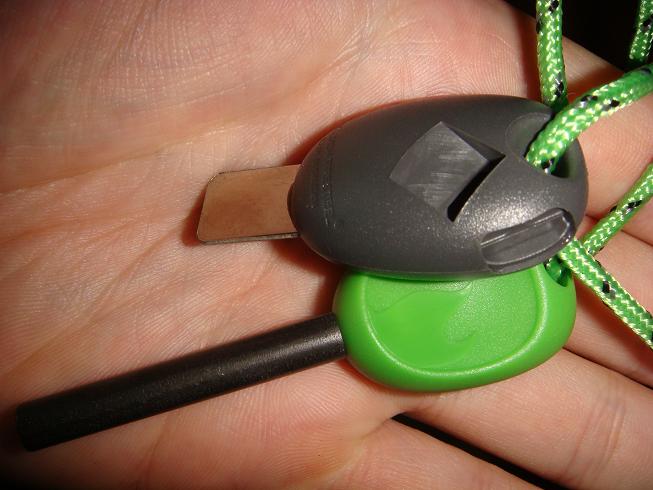
With that, I needed a new flint and decided to look for another Swedish FireSteel to replace the one that I had just broken. To my surprise, there was a new FireSteel on the market listed as a "2.0". It was a little bulkier than my previous FireSteel. The striker was shorter in length, but was incorporated into a whistle. The molded grips on both were much thicker than previous versions, possibly because others had the same problem I did.


The whistle I carry is an ACR because it was dubbed one of the loudest pealess whistles by the Coast Guard. Oddly enough, and having used it several times to get the attention of friends or scare off an unfriendly bear, I really don't find it to be that loud. In fact, the pitch itself is more annoying than anything and the sound really doesn't travel that well. I do like the fact that it doesn't require a ton of effort to blow, as it seems air seems to be better controlled. For many years before college, I refereed youth basketball. Any time I blow my ACR, I wish I had my old referee whistle which was easily capable of deafening anyone within the building. With a pea though, it is susceptible to freezing, so I leave it at home. I think the whistle most similar to my old referee whistle is the Fox 40 as it seems to have a rolling sound, although it exhausts air pretty quickly. Comparing the ACR whistle to the new FireSteel 2.0, they really aren't that similar as the FireSteel 2.0 sounds doesn't really generate a loud enough sound to be useful. The ACR is a little easier to blow because of the way the FireSteel 2.0 tried to incorporate it into a handle with a lanyard punch right next to the whistle part which gets in the way a bit.


Regardless, it's always nice to carry gear which is multifunction and the FireSteel 2.0 (http://www.light-my-fire.com/) may be perfect for your needs. As for me, I'll stick with the better whistle (either ACR or Fox 40 depending on my whim) and I'm debating on whether to carry the more robust flint stick.
UPDATE: One of our fine readers suggested the Exotac Nano Fire Starter (http://www.exotac.com) which is a lightweight and waterproof solution to fire rods otherwise damaged by sweat and moisture. I've got one on the way. They are a little more expensive, but it's nice to still be able to carry it around my neck and know that it isn't going to get damaged.

Wednesday, October 27, 2010

Oh Crap....Again.


When I started this blog I had many ideas running around in my head about what topics I would write about. Over the course of time, many topics addressed were out of obvious necessity while others were more organic and often based on an experience or a new product on the market.


One topic that has received several entries is one that I honestly can say I never anticipated writing about once, let alone multiple times. Yet the topic keeps rearing its ugly head and no doubt someone is going to imply that I may need to seek counseling. That person would probably be right.


Unexpectedly, Rob "Qiwiz" Kelly (http://www.qiwiz.net/), a fellow BackpackingLight.com member, sourced some titanium and was able to shape it into a trowel. Titanium holds a great place in the world of lightweight backpacking and quite honestly is a technology that really needs to be more integrated into this industry.  He offered the trowels to anyone with a couple dollars to spare and I was happy to have one.


The trowel was pretty unfinished, so I used my Dremel tool to smooth everything out, take away the straight edges and angles, and ultimately smooth the edges so it would be a trowel and not a weapon. I also purchased a rubbery dipping compound from my local hardware store which is used to put a grip on handtools as I was concerned about getting a nasty cut in the wilderness from the edges. After a few dips, I had a very nice and non-slippery handle that was plenty easy on the hands. Using a high speed drill, I punched a hole in it and added a reflective piece of Kelty Trip Tease. The trowel itself was the same size and shape of the famous Monbell Handy Scoop.


If you were wondering, the Monbell Handy Scoop weighs 39 grams and mine is 6.6 grams as a blank and 14 grams with the handle and cord. Consequently, a MSR Ground Hog stake weighs 15 grams, so needless to say I'm pretty intrigued with this little shovel. I've used it several times now and quite honestly it is really a great lightweight digging tool. It is plenty sufficient to get the job done and having something a little more substantial to dig cat holes with is a nice luxury.

Wednesday, October 20, 2010

Seirus Softshell Lite Gloves


For the most part, I would describe myself as a poor excuse for a four-season backpacker. The reason I will win no awards for my year-round backpacking activities is because I rarely backpack in the heat of the summer where there is only an abundance of bugs and hotness and not water. I also rarely backpack in winter, although not for lack of interest, as I have not yet quite developed the skills that I feel comfortable with for multi-day trips in sub-freezing temperatures. Something as simple as learning how to avoid freezing water bottles, how to control sweat, layering, etc. are not only topics of practicality, but in the case of extreme cold, I may very well be testing the limits of my safety. So on that front, I'll keep trying and learning.


With that said, I've found a pair of lightweight gloves work very well for me for the seasons I backpack. I have two pairs of gloves that can be pretty much used interchangeably as far as I'm concerned. The first is a pair of SmartWool liners (www.rei.com/product/755628, $18, 45 grams) and the second is a pair of New Zealand PossumDown liners (www.shopnewzealand.co.nz/en/cp/gloves, $15.30, 46 grams). Both are a no frills and very lightweight option. They aren't meant for much more than simple warmth in conditions where I won't be getting them wet. By the way, add the Mountain Laurel Designs eVENT Rain Mitt(www.mountainlaureldesigns.com/shop/product_info.php?cPath=37&products_id=51, $45, 35 grams) and you'll have a downright solid system in a wide range of conditions.


For winter conditions when I need something a little more substantial, I've been experimenting with the Seirus Softshell Lite (www.rei.com/product/743105, $45, 83g). They are made from Polartec Power Shield which block 98% of wind, which is my biggest gripe with the SmartWool and PossumDown gloves identified above. The Seirus is lined with polyester fleece and is made of 49% polyester, 35% nylon, and 16% spandex which essentially means they are stretchy, comfortable, and highly water and wind resistant. I also like the fact that it has a piece of fabric on the palm which helps with grip and long-term durability.
A couple of thoughts on the information herein. First, note that the Seirus gloves are nearly twice as heavy as the other two I mentioned. They are a far warmer and more durable glove however, and they are still very lightweight. They also do far better with water. Second, of all the gloves I mentioned, really the SmartWool glove is the only one that I'd feel comfortable with handling items off a fire. Synthetics melt - something I can say from experience when I badly burned my finger several years ago while picking up a cup from over a fire which quickly melted my glove causing one of the few times in my life where I needed to give myself backcountry first aid.

Wednesday, October 13, 2010

Camping with a 3-Year Old


Over the weekend I took my three-year old son camping at Big Meadows in Shenandoah National Park in central Virginia. At a young age, my parents exposed me to this wonderful place and I have returned several times per year for as long as I can remember. It was only fitting to me that this would be my son's first overnight trip in the park as I wanted to start the tradition early and impress upon him the importance, fun, and beauty that only the outdoors could provide.


Initially I interpreted my own actions to be equal to brain-washing, a practice utilized by most parents in one way or another as they try to shape their children to the people they want them to be. Much like with my favorite NFL team who hasn't been a real contender in nearly two decades and yet my children both wear t-shirts and hats bearing their logo, I wanted my children to love the outdoors as I do. Fortunately, the outdoors has a way of enticing young and old without much effort. The drive up Skyline Drive, known for its expansive vistas into the valley's below, was enough for my son to start remarking how "pretty" the view was or how "cool" it was to see farms far off in the distance. His positive comments continued when we arrived to camp with every passing deer or with general camp activities. By the time he was barefoot, stuffing s'mores in his face, getting memorized by the fire, or tackling me as I tried to sleep in our tent, I was pretty sure he was hooked.


The campsite I selected for this outing was one that I am all too familiar with and consider it to be one of the best in the park. It's a deep walk-in site which opens up to a field of oak trees which really no other site offers. The site is as secluded as it could possibly be for a public campground which proved to be worthy of this designation even during the peak season of October which packs the entire park with leaf-peeping tourists.


Oddly enough, it was the site itself that proved to be the most entertaining. At a young 3-years old, my son wasn't about to "hike" in any real sense, so our entertainment needed to come from the area surrounding our tent. I brought a soccer ball, his velcro baseball glove, several kid books, and plenty of food that neither he nor I should eat should we desire to be anything less than a sphere in our old age - yet keeps a 3-year old's interest quite well. Fortunately, entertainment was quite easy to come by without all the stuff I brought from home.


Throughout our time, especially during the night, we were visited by an endless amount of wildlife. I had a point-and-shoot camera with me which did nothing more than capture darkness when the sun was anything but high in the sky, so I have little tangible evidence of the remarkable nature encountered of our trip. Deer were as close as 1 foot to our tent at any given time often doing little more than crunching away on acorns as I had casual conversations with them explaining to them that my son and I were trying to sleep. We had a visiting owl who apparently felt the need to be quite conversational. We had a fox who used the area as his personal racetrack and and endless number of chipmunks who proved to be terribly illusive to my son who otherwise had never seen one before and did his best to capture one to hold it still long enough to have a good look at it. Coupled with a strong variety of birds, leaves of every shape, size, and color, and the comedy routine of me trying to cook kid foods over a fire and grill (lightweight cooking is so much more simple folks), my son didn't lack for entertainment.


Probably one of my personal favorite moments, although disturbing in the middle of the night, was when two small bucks decided to test their antlers against one another. This practice first started next to my tent in the middle of the night and then progressed to no more than 50 feet away once the sun came up.
Funny enough, I was amazed at how un-scared and un-bothered my son was with all the new things around him. He didn't care that he was sleeping outside and actually considered it to be quite fun. He didn't care that animals were making noise all night or that bugs made themselves known every now and then. Simply, he was camping and enjoying himself which was an experience I hope he continues to embrace in the future. I know I will and I look forward to the time when he is able to carry his own backpack, hike for more than a run around the campsite, and participate in the greater wilderness experience.
Regardless of the age of a child, whether wholly dependent on their parents or knee-deep with their own family, I think camping and outdoor experiences can't help but offer unique and memorable experiences that should be sought throughout a lifetime. It is more entertaining than any TV show or movie and fills volumes of dialogue with no verbal communication whatsoever.
Upon returning home, my son filled my wife with stories of what he saw and things we did. Before bedtime, unprompted by anyone, he grabbed several pillows and a couple blankets and organized them in our living room into what he described as his "tent". He then told me he wanted to sleep in our backyard tent at some point this week. Calling him "my little camping buddy" seemed to be plenty fine by him too and he seems to be a little more loving and happy since we returned.
One last thing worth mentioning which I say for young parents in a similar situation - at 2am while snuggled under warm blankets and sandwiched between cheap sleeping bags suitable for a kid, there is a huge difference between "I think I peed my pants" and "I peed my pants". Fortunately for us, it was the former.