Showing posts with label Lightweight Water Filter. Show all posts

Wednesday, October 23, 2013

Sawyer Mini Water Filtration System


The folks over at Sawyer were kind enough to let me test drive their new Sawyer Mini Water Filtration System ($18-$25/2oz).  The “mini” was a bit of a surprise to me because Sawyer seemed to already be leading the industry with the Sawyer Squeeze Filter which received quite a bit of press in the last year.  The beauty of both systems is that they are reliable, effective, and flexible enough to offer a variety of configuration preferences (i.e. squeeze, inline, straw).  Both also come with a straw as well as squeeze bottles.  The squeeze bottles have been improved from the first release of the Sawyer Squeeze and both filters continue to fit Evernew bottles and likely other options.


While I was already a user of the Sawyer Squeeze Filter, the beauty of the Sawyer Mini Water Filtration System is that it is physically smaller, lighter and less expensive – but the effectiveness remains the same.  At 2oz and roughly $20 for a .01 micron absolute filter capable of removing 99.99% of bacteria, protozoa and cysts for up to 100,000 gallons – this is a product that comes with its own cheering section.


The filter is essentially a cluster of micro-fibrous tubes.  Water is drawn through the side walls of the tubes into their hollow center and out of the end of the tubes.  Harmful bacteria and protozoa is trapped on the outer walls of the tubes delivering fresh and clean drinking water.


Lightweight backpackers, almost by necessity, are fairly meticulous about the gear they carry.  Making decisions based singularly on grams and ounces can quickly yield to a declining fun-factor.  As a result, there is a middle ground between weight and overall comfort.  In my quest for lightweight water treatment, my personal backing history has run the gamut from pumps to chemical treatments.  Looking back, using a pump nowadays is like continuing to carry an Army cot and gas lantern.  They are bulky, expensive, and prone to failure.  Anyone who has had their hand slip off the pumping feature will quickly look for an alternative solution once their hand recovers from being pinched (or worse) and dealing with a clog is an unfriendly nightmare.  UV options are pricey, prone to easy damage and depending on the model, batteries may be hard to locate.  UV options are also only effective in water that is already clear and only for a set volume.  A pre-filter is a good idea, but adds another step and element.  Lastly, UV options may kill water nasties, but it doesn't remove them.  Personally, the knowledge of chugging "dead" nasties doesn't make me overly thrilled.  More often than not I've relied on chemical tablets.  Tablets are effective and lightweight, but gram for gram they are fairly expensive and do nothing to filter out floaties and other nasties.  Usually I use a biodiesel bag or tulle as a prefilter.  Personally, I’m not thrilled about putting chemicals into my body or their cumulative effect.


Fortunately with the Sawyer Mini Water Filtration System, weight, cost, nor effectiveness are reasons to leave it at home.  It is lightweight, affordable and effective.  I’ve used it repeatedly for the last three weeks in several different environments, temperatures and in conditions of varied turbidity.  Out of the box, my first use was dipping the bottle into a stream.  I turned the bottle over and expected it to take quite a while to prime the filter.  To my surprise, clean water flowed out almost immediately.  A second misconception was put to rest when I noted that I didn’t need to squeeze or suck on the nozzle to get a sufficient water flow.  Basically, it worked like a charm without additional effort.


Aside from the fact that is an inexpensive, effective and less bulky option than other physical filters, I like the fact that the drinking nozzle has an effective cap cover.  While this comes into play to keep grit out of the drinking end, I quickly learned that it avoided cross contamination when the bottle and filter fell off a rock into a stream while I was photographing it for this article.  Verifying that the filter wasn’t compromised because of my own carelessness was a nice unexpected benefit.  Having reviewed other water filters on this blog, the protective cap on the Sawyer Mini Water Filtration System is a rarity on other filter options as either they are missing entirely or are manufactured without expectation for them to last more than a few uses.


The Sawyer Mini Water Filtration System comes with a large syringe to back-flush the system, but it is a little bulky.  Others have found a compatible cap to work with a spare bottle and detailed its use at BackpackingLight

Mini Bull Designs also offers a unique adapter for $10 as well as a screw top for the Sawyer Squeeze for $15 which I prefer and own.

 
I enjoyed the flexibility of using it as a gravity filter or with a straw, but most commonly I simply drank straight from the bottle.


Aside from a smaller, lighter and equally functional back-flush option as described above, I would personally like to see see-through bags and bags with a means to hang them upside down (i.e. hung from a tree) or stand-up on their own.


When all things are considered, the Sawyer Mini Water Filtration System is simply the best overall lightweight filter on the market whether for lightweight backpackers or anyone looking for an inexpensive, lightweight and effective water filter in a very reasonably-sized package.  While there are other more effective filters, they are also more costly, bulky and inconvenient.


For general information about water nasties, below is part of an article I previously authored which helps illustrate why a .01 micron absolute filter is critical.


PROTOZOAN CYSTS – These are hard shelled, single-cell parasites which include Giardia and Lamblia and range in size from 5 to 15 microns. This also includes Cryptosporidium Parvum which is 2 to 5 microns in size. Giardia occurs in the small intestine where cysts hatch and give you diarrhea, gas, nausea, and/or cramps and symptoms appear within 1 to 2 weeks and can last 4-6 weeks or longer. Those with weakened immune systems could be more heavily impacted. Cryptosporidium can give you similar symptoms and can also include loose stool, cramps, slight fever, and an upset stomach. These systems generally appear in 2 to 10 days and typically last 2 weeks. Animals and humans carry Protozoa.

BACTERIA – Bacteria are smaller organisms which can include E. Coli, Salmonella, Cholera, and Campylobacter Jejuni. They range from .2 to 10 microns and symptoms include diarrhea with appears within 6 hours or 3 to 5 days and last 4 days or longer. Animals and humans carry Bacteria.

VIRUSES – Viruses represent the tiniest of organisms ranging from .004 to .1 microns. They include Hepatitis A, Rotavirus, Norwalk Virus, and even Polio. Although these are the least commonly found pathogens in the wilderness water sources, they represent often the most harmful. If you were wondering, most waterborne viruses which affect humans in the backcountry come from human fecal matter.

CHEMICALS AND RUNOFF – As the name implies, another water-nasty includes agricultural runoff (herbicides, pesticides, etc.) and industrial runoff (metals, mine tailings, etc.).


(Disclosure: This product was provided to me free-of-charge for the purposes of this review and is owned by me.  However, any information contained herein is my personal opinion without bias.)

Wednesday, January 4, 2012

Meet the LifeStraw (and other water treatment devices)


Do you know Warren Doyle?  If you don't, you should at least be impressed by his accomplishments. Doyle has hiked the Appalachian Trail a record 16 times (!!!) over the course of last several decades and has 34,000 lifetime miles under his belt. He holds a PhD and even offers classes for potential Appalachian Trail thru-hikers.  Reading up on Doyle, one of the most unique things he does to cut weight (aside from slack-packing much of the way now that he is in the twilight of his life) is that he does not bring any kind of water treatment with him. He simply drinks from water sources he finds along the trail.  Now granted, he exercises an abundance of common sense such trying to get water as close to the original direct source as possible, avoiding visually defunct sources, ensuring he is not downstream from agricultural runoff or animal feeding areas, etc.

Assuming the rest of us aren’t that trusting and treat our water to some degree, we each likely use a variation of chemical treatment, UV light treatment, or filter option.  Throughout the years I tried each of these to varying degrees and elect to bring one over the other depending on the situation and environmental conditions.  At some point I even used a homemade inline water filter with scrap parts from MSR and Sawyer, but found the whole system to be entirely too finicky and cumbersome.

My first treatment option was a PUR pump filter (380g).  From the start I hated it.  It was clunky, expensive, heavy and clogged.  In fact, it has sat in my closet unused for the last 8 years or so after crushing my hand in the pump mechanism following getting the handle wet where personal fatigue and a slip caused the pump to crush down on my fingers.


My second option was a AquaMira Frontier Pro (57g/$25) which screws nicely on top of a small mouth bottle and treats most everything I’d come in contact with.  I’ve found this filter to be quite wonderful for the size, cost and efficiency.  A close relative is the Frontier (18g/$10) which is designed as an emergency filter.  With its small size, it is a packable item that can make it into a travel kit if there is a concern for water issues and may be suitable for the weekend warrior not needing a voluminous water treatment option.

Over the last couple years, treating water with ultraviolet light has become popular.  I used the Steripen Adventurer (66g/$100) for several outings and found that I’d rather leave it at home.  It’s heavier than I’d like, expensive, uses batteries, susceptible to breaking, does poorly in water that is anything but nearly clear, doesn’t do well in treating water when the water vessel is larger than the size recommended for the unit, etc.  I have no problems taking it with me traveling, but for the most part, it sits on a shelf.

For the last several years I’ve primarily used the chemical treatment Katadyn Micropur ($8 for 20).  It is a small, lightweight, and inexpensive tablet.  I use this product with some kind of homemade pre-filter, like a nylon mesh bag and coffee filter, or a 1 micron biodiesel bag.  For me, this option has been wonderful and effective.

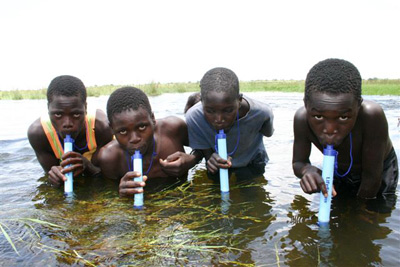
A product offering similar performance to the filters above called LifeStraw (www.lifestraw.com) is better known in third world countries and persons planning for emergencies than to backpackers.  Of no surprise after reading the accompanying marketing literature, this product was originally created to help those affected by the Haitian earthquake and floods in Pakistan.  It is also frequently used by Faith-based organizations servicing impoverished countries on behalf of the United Nations and holds numerous awards to include those from CNN, TIME magazine, and others.

So why should you care about LifeStraw?  Well, it is as effective if not more than the filters mentioned above and costs a measly $19.  LifeStraw purifies a minimum of 1,000 liters of water over its lifetime (AquaMira Froniter can only handle 20 gallons) and removes up to 99.9999% of bacteria and 99.9% of protozoan cysts.  It is a good option for those with a tight budget and everyone with an emergency home or car kit.

LifeStraw is a tube capped on both ends with a filter on the inside and otherwise no moving parts.  After uncapping the ends, the user simply dips the bottom portion into the water source and sips from the other end.  I found the flow to be comparable to the Frontier Pro which is the easiest for me to use.  It comes with a helpful lanyard and the caps help avoid dirt and cross contamination. 

In a publication from Vestergaard Frandsen Group S.A., it was noted that he plastic pre-filter located at the bottom of the LifeStraw removes coarse particles larger than 1mm while all particles larger than .2mm were stopped (small enough to stop protozoan parasites and bacteria).  Most backpackers look for filters capable of stopping particles 3 microns and under for it to be effective.  Cleaning it by blowing through it seems to work as well as it does with other options.  A University of Arizona study further stated that LifeStraw performed “well” when challenged with “worst case” water quality as likely in third world countries, a claim that likely these other manufacturers can’t offer.  This study showed that LifeStraw removed 99.9999% of bacteria and 99.9% of Cryptosporidium cysts thereby complying with U.S. Environmental Protection Agency (EPA) requirements.  In the event that you’ve heard of the LifeStaw previously, worth noting is that it no longer uses carbon or iodine and has meets standards for water filtration of bacteria and protazoa. 

As I mentioned, this is a nice option.  You can purchase yours at Green Beetle Gear (http://www.greenbeetlegear.com/).

For a more expansive understanding of water nasties, check out my earlier post at http://jolly-green-giant.blogspot.com/2009/03/lightweight-water-treatment-options.html some of which is posted below for reference:

1) PROTOZOAN CYSTS – These are hard shelled, single-cell parasites which include Giardia and Lamblia and range in size from 5 to 15 microns. This also includes Cryptosporidium Parvum which is 2 to 5 microns in size. Giardia occurs in the small intestine where cysts hatch and give you diarrhea, gas, nausea, and/or cramps and symptoms appear within 1 to 2 weeks and can last 4-6 weeks or longer. Those with weakened immune systems could be more heavily impacted. Cryptosporidium can give you similar symptoms and can also include loose stool, cramps, slight fever, and an upset stomach. These systems generally appear in 2 to 10 days and typically last 2 weeks. Animals and humans carry Protozoa.

2) BACTERIA – Bacteria are smaller organisms which can include E. Coli, Salmonella, Cholera, and Campylobacter Jejuni. They range from .2 to 10 microns and symptoms include diarrhea with appears within 6 hours or 3 to 5 days and last 4 days or longer. Animals and humans carry Bacteria.

3) VIRUSES – Viruses represent the tiniest of organisms ranging from .004 to .1 microns. They include Hepatitis A, Rotavirus, Norwalk Virus, and even Polio. Although these are the least commonly found pathogens in the wilderness water sources, they represent often the most harmful. If you were wondering, most waterborne viruses which affect humans in the backcountry come from human fecal matter.

4) CHEMICALS AND RUNOFF – As the name implies, another water-nasty includes agricultural runoff (herbicides, pesticides, etc.) and industrial runoff (metals, mine tailings, etc.).

(Disclosure: This product was provided to me free-of-charge for the purposes of this review and is owned by me.  However, any information contained herein is my personal opinion without bias.)

Wednesday, May 4, 2011

Meet the Super Delios Water Filter


Thanks to a comment made by fellow blogger http://www.blogpackinglight.wordpress.com/ in response to a recent article I wrote about a lightweight water pump, I was introduced to the Super Delios Portable Water Purifier (http://www.delios.co.uk/). It quickly became one of my favorite outdoor products one which I encourage you to check out.


For those who aren't American, chances are you already know about this product and likely even use it. Sadly, despite holding an American patent, I haven't found a single American who uses this nifty little system and I'm unaware of any American vendors. So, fellow Americans, behold....


The Super Delios filter is essentially a 40g filter capable of filtering 1,000 litres of water (depending on quality) and provides an impressive 0.2 micron protection capability which means it will protect you from bacteria, e.coli, salmonella, giardia, cryptospordium, cholera, and dysentery, all the little organisms that hikers like you and I would like to avoid. Generally speaking, anything less than 0.3 microns is considered a good choice.


The beauty of this Japanese product is its simplicity. It's already lighter and smaller than the Aqua Mira Frontier Pro and a lot less hassle than pumps or gravity options. Simply, screw it on to any compatible bottle and you're good-to-go as all you need to do is squeeze the water into your mouth which is already filtered by the time it comes out of the top.


When purchasing, you have a couple options. You can buy the one I'm referencing to screw on a like-bottle (or a bottle provided by the manufacturer) or another option for a gravity system (and bag provided by the manufacturer). The Super Delios is about $44 to include shipping to the USA.


When viewing pictures online, it reminded me of the filters used for my refrigerator. I assumed it would be big and clunky. My mindset quickly changed when I received the product. It is 3" tall and 1.5" in diameter, very reasonable - and light. Instead of purchasing the manufacturers bottle which I thought was too small and a little heavier than I'd like, I'm using it with a 1 litre flexible Platypus bottle which works just fine. Part of this system requires that the bottle be flexible so it can be squeezed to force water through the filter. Because I've popped a couple bottles similar to the Platy (specifically Nalgene's which I won't use anymore because of these failures) I was worried that I'd burst a seam if it required a lot of pressure. Fortunately, especially once the filter is used for a few seconds, it doesn't take much pressure at all to get water out.


So when would I use this little gizmo? Well, I generally use Katadyn Micropur purification tables (search my blog for my reasoning). They are inexpensive, extremely lightweight, pack very small, and are quite effective. But...they don't do anything for any water floaties. For this reason I carry a little nylon bag to act as a pre-filter which I use to remove any floaties of significance and I'm otherwise pretty careful about my water sources. However, during certain times of the year like April, I find that the weather is so rainy that it stirs up so much sedimentation that my "pre-filter" could be better. So, when the weather is particularly fowl, I'll carry either the Frontier Pro, or now, the Super Delios. For my needs, it's great, although the price tag is a little more expensive than I'd like. But let's be realistic about price because the reality is that the Delios is far LESS expensive than many option. Take for instance my Micropur tablets. They are essentially $10 for 20 tablets. Considering each tablet is good for one litre of water, that essentially means it costs me 50 cents per litre. The Super Delios is good for roughly 1,000 litres. At $44, that's about 22 cents per litre. Regardless, the Super Delios is a wonderful option for backcountry use. What's not to like - effective, small, reusable, lightweight, and really, not that expensive in the grand scheme. To take it one step further, picture carrying 1,000 Micropur tablets versus one Super Delios. The Super Delios would win in size and you wouldn't need to fumble around with 1,000 little tablets and deal with their trash. The Super Delios clearly has merits, although granted, I don't see anyone carrying 1,000 tablets anyway. Another nice thing about the Super Delios vs. tablets or other non-filter options is that you can drink from it right away versus waiting for some chemical reaction (not to mention some people don't want to ingest chemicals regardless of how many studies that say they are harmless.)


I think my only gripe about the Super Delios, with exception to the overall price and lack of availability in the U.S., is the extremely cheaply manufactured lid. Basically, it requires care for long term use because if it breaks off it would allow water to come out unintentionally which would be very problematic if carried in a pack. The manufacturer is aware and I suspect it will be updated in the future. Overall though, I really like this product and highly recommend it. I also want to clarify that I'm not knocking the Frontier Pro. It too is excellent and the real bonus with it comes in the fact that the filter can be easily removed and replaced inexpensively...without needing to purchase a whole new unit.

Wednesday, April 20, 2011

Lightweight Water Filter


If you're a lightweight backpacker, you probably use some kind of tablet or chemical to treat your water. After all, these are probably the lightest options. However, some simply can't get past the perceived risk associated without using a more conventional and robust filter, like a pump.


Unfortunately, at 10-20oz, pumps aren't light. With seals, filters, and mechanics, pumps run the real risk of breaking or clogging which would render the expensive little gizmo fairly useless. Yet, some stick with it. Well, if you were wondering where you could find the lightest pump, check out the Nano Technology 530 (www.sportsimportsltd.com/530gacamicew.html), sale - $74.95.


The Nano 530 is a ceramic filter pump which can filter down to 0.1 microns which is about half the size of other commercial filters. It is only 5.5" tall and weighs an amazing 3 ounces. Because the filter is ceramic, it can also be cleaned which extends its life.


For those that may be interested, reviews say it works, but plan on gaining little output following a lot of work due to the small size. Five minutes of pumping per liter may be expected.


If you want to read up on filtering options and the nasties in water, check out my 2009 entry at http://jolly-green-giant.blogspot.com/2009/03/lightweight-water-treatment-options.html.