Wednesday, January 26, 2011

Ode to Finland!


Backpacking and nearly anything outdoors is a hobby of mine, one which quite literally keeps me sane from otherwise long work weeks and stresses of life that would otherwise likely swallow me whole. Because it is a hobby, it means I have limited time to devote to it. For the time I do have, I strive to use my time wisely.


One of the ways I supplement my interest is through online resources such as blogs or backpacking forums. I'm always very appreciative when I stumble across a site that brings with it clarity of thought, conciseness of language, a sense of humor, and content consisting of original thought. It is this assessment that led me to be a regular lurker to Hiking In Finland (http://www.hikinginfinland.com/) run by Hendrik Morkel, a self-described entrepreneur of an environmental management consulting company. Aside from his top notch website with the features I already mentioned, he supplements his content with excellent pictures, trip reports, and comments on first-hand gear choices which I personally appreciate. And let's face it, the guy can grow an impressive beard. Hendrik must be on to something considering Forbes magazine rated Finland just behind Norway and Denmark as the "World's Happiest Countries".


Late in 2010, Hendrik was kind enough to offer up a couple of Kupilka cups to his readers. The Kupilka, to my understanding, is a mainstay in the pack of many bearded guys living in Finland. I personally love these kinds of traditions for many reasons. I think the world scoots along at a pace which often leaves many unable to reflect on the past and appreciate the present. Much of life has become disposable and each generation seems to push further and further away from fundamental ethical boundaries and the practices of their ancestors. In some cases this is necessary and welcomed, in others - it's a shame. Aside from the inherent functionality, carrying the Kupilka expresses a nice nostalgic and respectful sentiment while perhaps introspectively acknowledging the simplicity of nature and those that came before us.


Much to the surprise of someone who quite literally has never "won" anything (me), Hendrik informed me that I had won one of the Kupilka cups. Within a few weeks, sure enough it was on my doorstep complete with a Finnish postcard, Swedish hot chocolate, and a peppermint liqueur made in Finland. In as much as I appreciate the generosity to ship something like this across the pond, I more greatly appreciate the sentiment that came with it and the education of the cup, the culture, and the tradition.


So publicly - thanks Hendrik! I used the Kupilka for the first time in a late December snow. Not being a regular snow camper nor one to bring anything other than a single cooking cup, it was quite welcoming to have a secondary cup which enabled me to forgo the use of freezer bags to scoop my meal. About 10pm that night, shortly before bed, I raised the Kupilka in a north easternly direction to pay homage to a good man, with a good blog, in an intriguing country.


Visit Hendrik at http://www.hikinginfinland.com/. Thanks Hendrik.

Wednesday, January 19, 2011

A Little Bit About Not a Lot...

Happy New Year everyone. It's only taken me 6 weeks to find my blog again. I decided I needed a break, so I took one. I'm not sure how 2011 will shape up, but I look forward to blabbing away incessantly on things that may or may not interest you. As always, I appreciate the time you take to check in and give me your input.


2010 was a bizarre year for me as it relates to this blog, specifically the content. It's one of the first years in recent memory which I really didn't feel was a banner year for the lightweight backpacking industry. The Outdoor Shows seemed promising, no doubt just as the one this week will entice, but as a whole there was just little new innovation or product development. On one hand, more manufacturers popped up and competition is always nice. On the other, these new manufacturers seem to all be offering products that are nearly identical to one another. After all, how many different ways can you build a cuben tarp or mid?

I guess the result for me was that I spent less which is probably a good thing overall. If there is one thing I've realized the more knee deep I get into this industry it is how much less and less I need as I gain more experience and knowledge. Having the newest and greatest gear is great, but often unnecessary and not worth the expense. On another level, it is also irresponsible. I believe most backpackers would identify themselves as stewards of the environment. Being an endless consumer of unnecessary gear ultimately challenges this sentiment.

2010 also gave rise to a lot of backpacking blogs which I personally wasn't entirely thrilled with because it seemed so many rehashed the same old mantras and gear which isn't really worth the read or effort it took to write it. Course, that's just my opinion and I'm sure I'm guilty of this too to a certain extent despite my best efforts to primarily focus on new stuff not widely discussed.

Probably like you, from time to time I visit camping stores like REI, EMS, Blue Ridge Mountain Sports, etc. just to see what mainstream gear is inhaling money away from the general public. I don't think I ever tire of the sales speech as some inexperienced buyer gets sucked into endless pounds of gear all because some kid with a name tag and smock read too many outdoor magazines and projects the sentiment that the outdoors is a wild place full of wild creatures which poses an eminent threat. That threat, of course, can only be mitigated with pounds of costly indestructible gear. It's not that I don't think there is a place in the industry for this kind of stuff, it's just that I hate to see impressionable minds misled. It took me decades to break the habits taught to me in the Scouts to realize that I didn't need to be in a bullet-proof gerbil ball merely for a stroll through the woods. Granted, to each his own and everyone should bring with them that which they are able to use safely, responsibly, and to suit their own comfort needs, but so often this gets out of hand. Sales seem wholly dependent on scaring the buyer instead of educating them.

Other than buying fuel, fondling outdoor gear just because it is outdoor gear, or grabbing something for car camping, I really rarely buy things in these stores in as much as I fully support them. Oddly enough, if I did more car camping or camping with my family, I'd probably have no problem spending more at these businesses. To me, despite my lightweight preferences when backpacking, I quite literally have no problem bringing just about anything I can get my hands on when car camping. King Serta Mattress? Sure! Stocked refrigerator? Definitely!

My most recent trip to local camping stores pointed out some things that held my attention for a while, but remained on the shelf after I left. I figured it might peak some of my readers interests, so here you go.

The Buck Smidget Knife ($20/1.3oz/42.5g), www.rei.com/product/786636 is an extremely light, easy to sharpen, full tang knife which comes with a lanyard, key fob, and molded sheath. In the backpacking community, there are "knife people" and everyone else. I fully appreciate the need for a solid knife in the backcountry. In fact, I've been learning about bushcraft lately for no other reason than I like learning about how our ancestors likely increased their comfort level. But truth be told, knives are necessary for survival or perhaps for making kindling for winter stoves. Other than that, they really are nothing more than dead weight for backpackers who are carrying a map, phone, and are probably pretty close to civilization. So in spirit I'd love to carry a nice Rambo knife for that grand "just in case" factor, but 99.9% of the time I've gotten by just fine with a Swiss Army Classic or less. If I'm backpacking in winter with a wood stove, I'll bring a Mora to hack up pieces of wood. Nonetheless, the Smidget may interest some of you. I personally liked the molded sheath and the fact that it could be lashed to a pack. At 8.13", it's a nice overall size. Unfortunately, the handle is rough, jagged, and will no doubt be slippery at the first sign of wetness. If this knife intrigues you, you likely also know about the Baladeo knives which at 22 and 34 grams are both lighter. The Baladeo comes with it a host of problems though. First, it's nearly impossible to sharpen in the field. Second, the blade is exposed when closed, which although not sharp to the outside, just screams "bad idea" to me and would likely get caught on just about everything. Third, if one is going to take the trouble of carrying a more substantial knife, it should be more accessible. The Baladeo doesn't come with a sheath and doesn't appear too lashing-friendly. Fifth, and again playing on the fact that if you decide to bring a knife that it would be better to bring a real knife, I'd rather have a fixed blade. Lastly, the Baladeo is also plenty slippery when wet. By the way, if you want a pretty cool sheath for your Mora, check out Dad of All Trades (http://www.dadofalltrades.com/). Moving on.


One item I did like to a certain extent was the EMS Packable Pack ($30/9oz) http://www.ems.com/product/index.jsp?productID+3655806s.com/product/index.jsp?productID+3655806. A 70D nylon ripstop 1500 cu/in top loader isn't too shabby for service as a summit pack or to tote stuff around town or use when traveling. Course, if you're a legit lightweight backpacker, you probably already have a pack that isn't breaking your back and you can skip the need to switch to something else just to summit.

And...that concludes my walk down memory lane as it relates to these stores because there really wasn't anything else to tinker with and titanium pots are slowly looking pretty similar. That causes me to reflect on my own personal favorite gear from 2010....


I continue to think Bender with Kookabay (http://www.kookabay.com/) is just about the best value for a quality and lightweight inflatable sleeping pad. In fact, the product that he has privately brought to market is really quite remarkable with great service and quality workmanship to boot. Folks, this is how it should be done. Still, for some reason my CCF pad makes the trip more often then not as I still count ounces. For nights in a shelter, CCF just doesn't cut it and that's when my Kookabay pad shines.


I also really appreciate the work being done at GooseFeet (http://www.goosefeet.webs.com/). I had been looking for a pair of down socks for several years and refused to get the heavier booties so prevalent in the market. Simply, it was a niche that no one else really offered and it's no surprise that this product is taking off. A warmer product lighter than a sock - yes please.


Although a simple cat food can and some tin foil is a more than acceptable backcountry UL stove, I seem to have a hard time leaving my Trail Designs Sidewinder Titanium Ti-Tri behind (www.traildesigns.com/stoves/caldera-sidewinder). It's pricey at $79, although not much more so than a lot of other stoves, but I just can't beat the flexibility this three fuels system and outstanding pot stand offers. As I watch people fumble and bumble with their high-dollar stoves or try to scrape up Ramen from a pot stand that blew over from the flutter of a gnats wings, I'm content with my little efficient stove.

So there you go - a little bit about not a lot. I hope everyone is able to get out in 2011. Trust me when I say this - nothing new will happen on Jersey Shore (and it's not like it makes you smarter), movies will be little more than remakes of older versions which were done better, and your work situation won't become any more desireable even with the addition of a young and vivacious intern who doesn't quite follow reasonable social standards associated with the business dress code. Well, maybe that last one isn't truly accurate, but you get the idea. Get out!

Wednesday, December 1, 2010

UL Rain Kilt


Zpacks (http://www.zpacks.com/) was really one of the first cottage manufacturers to use cuben fiber. In fact, owner Joe Valesko uses it nearly exclusively and his own backpacking endeavors proved its long-term staying power in the lightweight backpacking industry. When I really want to test how light I can go, I bring along one of his Blast packs and Hexamid Duo tents. Both are so absurdly light that it's nearly comical.


As I've mentioned before, I usually bring a ULA-Equipment Rain Wrap with me for my lower body. To me, it's a multi-use item as it not only keeps my lower body relatively dry, but it is a nice extra piece of sylnylon which I've used as a ground cloth, quilt protector, pillow, and vanity cover when bathing or doing laundry on the trail. I've also rigged it to my Hexamid to serve as a door in severe weather.


Zpacks has decided to make this already great idea a little better by making it out of cuben. The TrailLite Designs Cloud Kilt for $55 is a mere 1.6 oz and is essentially the same product. I've asked Joe to see if he can tinker with the design a bit to make it a dual-use item specifically designed as doors for his Hexamid line.


Now before you start saying a kilt isn't for you, think about it long and hard. Aside from the multi-use aspects which a pair of rain pants just can't offer, a skirt/kilt is easier to put on, offers better ventilation, is lighter, and really keeps the vital stuff dry. As one poster mentioned when talking about gaiters, few seem to care whether their shins or ankles are dry.

Wednesday, November 24, 2010

Nano Striker


One of the great things about blogging is the collaborative environment it inherently creates as people openly share their knowledge. Backpacking further brings with it a community which shares an unspoken bond of good naturedness and apathy which I've long appreciated.


In a recent blog I talked about a new flint striker that I wasn't thrilled with and one of our readers (Thanks Basti!) brought to my attention another great video by Jason Klass (http://www.geartalkwithjasonklass.com/2009/12/exotac-nano-striker.html) in reference to a product by Exotac known as the Nano Striker.


The Nano Striker is a ferrocerium rod encased in aluminum (or titanium if you have the money). Why is this useful? Well, I carry my flint striker around my neck and the sweat from my chest has degraded it substantially. Rather than have it clanking around outside of my shirt and getting caught on branches, the Nano Stricker is a nearly ideal solution for my needs because it keeps it dry. Course, Jason and his readers figured this out a year ago when he posted his video. SORRY, I missed it!


The Nano Striker is $27 ($75 for titanium) and comes in at 14.5 grams. I like the fact that it comes in multiple colors depending on whether you need it to be obnoxious or not. For example, mine is blaze orange as keeping it highly visible while backpacking is important to me.


The unique aspect of the Nano Striker is that the user essentially unscrews it to gain access to the ferrocerium rod and striker. One end is screwed to the rod side to make the handle longer which overall creates a very nice system. The striker itself is very short, but very sharp and can even be further sharpened if necessary. It claims to last for about 1,000 strikes. The aluminum is aircraft grade and little rubber rings help ensure the contents remain dry. It comes with a lanyard and extra rubber ring in addition to a nice little box and instructions.


Wednesday, November 17, 2010

Lightweight Compass


A compass is one of those pieces of gear that is critically vital in an environment where getting lost is a reality. Talking about compasses could be quite a lengthy and in depth conversation - one which you won't find here as others have covered it far more effectively.


Oddly enough, a compass is only somewhat useful in the areas I hike due to the extensive tree canopy and lack of observable land features. As a result, I have absolutely no need for a high-dollar compass capable of not only telling me direction, but making me breakfast.


With that said though, that doesn't mean I'd ever leave a compass at home. For example, the Appalachian Trail is a north/south trail. A running joke of AT thru-hikers when getting up in the morning is the silly question of "what direction are you heading today" as the choice is painfully obvious. Still many get lost on the AT and surrounding trails, not because the trail isn't well marked, but because side trails often aren't as well marked and trips into the woods quickly help any sign of a trail or direction disappear.


For as well marked as the AT is, I've honestly almost gotten lost several times. These situations have all occurred after a trip into a densely forested area to look for water, a bathroom area, or a stealth area to set up camp. Unless the ground is perfectly level, which it rarely is, I can walk a couple dozen feet into the forest only to turn around and find that the trail is completely gone from my perspective. Trust me when I say not immediately seeing the trail is unsettling.


To ensure I'm not the next SAR rescuee paraded around on a local newspaper, I generally do two things to ensure my direction. First, and something that works well on the AT, I take a quick look at a button compass I carry and ensure I fully appreciate the direction I'm heading. When I get to where I'm going, especially if I'm staying the night, I often arrange some sticks or stones to point me in the direction out. This may be vital if needing to make a quick escape in the middle of the night from any number of potential issues.


Although some may genuinely need a full-scale compass, a button compass is something I have found to be ideal for my needs. It is smaller than a penny, weighs virtually nothing, and is quite accurate. I like the Mini Tracker Survival Buttom Compass from Best Glide Aviation Survival Equipment (http://www.bestglide.com/). It is a NATO approved liquid-filled compass also endorsed by the Boy Scouts of America. It comes in a 14mm and 20mm size and functions from -20f to 120f and is water resistant to 30 ft. At less than $3, it's one of those pieces of gear which really should never be left home. I carry it regardless even though my Suunto Core watch has a compass built into it, which as I learned about a month after purchasing the watch, the digital compass can be quite wrong.


I always carry a whistle around my neck and I found that adding a button compass to it with some Super Glue makes the compass perfectly available, out of the way, and handy - plenty easy for a quick glance without fumbling through my pack or pocket. On a side note, Super Glue is amazing stuff. Although I usually purchase several button compasses at a time, I recently tried to get one of the compasses off a whistle to relocate it to something else. Bottom line - it wasn't moving, so feel plenty confident in a little glue.


Wednesday, November 10, 2010

Meet the Exped SynMat 7 UL - Rival to the NeoAir


In July 2010 at an Outdoor Show in Germany, Exped (http://www.exped.com/) revealed a sleeping pad which would easily compete with the famed NeoAir. Personally, I wasn't a big fan of the NeoAir for many reasons, but it does have a following. More correctly, people either love it or hate it and one could probably read between the lines a bit when it was announced that Thermarest was redesigning the NeoAir for the coming future.


The Exped SynMat 7 UL in an insulated sleeping mat which weighs just 16.57 ounces (470 grams) for a rectangular 72.04"x 19.68" (183x50cm) and an intriguing R-value of 3.5. Insulation is synthetic which is laminated to the top and bottom of the inner walls. This makes it significantly warmer than the NeoAir which is claimed to retain an R-value of 2.5 for nearly the same size and weight of 14 ounces.


Like the NeoAir, the Exped SynMat 7 UL packs down to the size of a half-liter water bottle and comes with a unique "flat-valve" system which enables the inflation and deflation valves to be separated and thereby is claimed to be easier to operate.


If you aren't a fan of lighter and cheaper (but more bulky) closed cell foam pads, and the NeoAir isn't in your gear closest for one reason or another, the Swiss Exped SynMat 7 UL might just be an answer for you...when they are put on the market. So when it that? Well, in north America it won't be until March. At that time, two sizes will be available (Small 64"x21" and Medium 72"x21"). There is discussion on a larger size which is believed to be 78"x20".

Wednesday, November 3, 2010

Swedish FireSteel 2.0 & Whistles


If you backpack, there is a good chance you carry something to make a fire. If you are responsible, you likely have some redundancy being that the ability to make fire may be the difference between life or death, or more likely, a tasty marshmallow or warm meal. Redundancy in fire tools usually includes matches, a lighter, fire plug, or some kind of flint.


Like many backpackers, I generally carry a necklace with a few things on it. Whether as a last ditch effort for safety or peace of mind if I ever get separated from my backpack, it's something I always have. On it is a flint striker, whistle, and microlight. On the whistle, I glued a button compass which has probably been more useful then anything else when I need a quick direction reference. I've gone back and forth with whether to include my Swiss Army Knife mini as it is a bit cumbersome to have all this stuff around my neck even though I find it to be very useful and far more available if not otherwise stuffed in a pocket or sack.


About a month ago I was studying my necklace for wear and noticed that my flint was pretty worn both from use and likely from my body sweat. I also noticed the molded handle was cracked. As I tinkered with it to see how bad it was cracked, it came completely apart. I think it's fair to say that holding more on the flint than the handle in the future will probably be a smart choice.


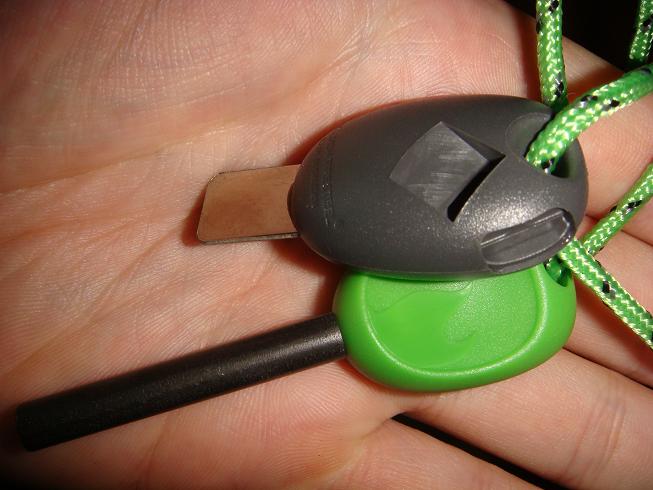
With that, I needed a new flint and decided to look for another Swedish FireSteel to replace the one that I had just broken. To my surprise, there was a new FireSteel on the market listed as a "2.0". It was a little bulkier than my previous FireSteel. The striker was shorter in length, but was incorporated into a whistle. The molded grips on both were much thicker than previous versions, possibly because others had the same problem I did.


The whistle I carry is an ACR because it was dubbed one of the loudest pealess whistles by the Coast Guard. Oddly enough, and having used it several times to get the attention of friends or scare off an unfriendly bear, I really don't find it to be that loud. In fact, the pitch itself is more annoying than anything and the sound really doesn't travel that well. I do like the fact that it doesn't require a ton of effort to blow, as it seems air seems to be better controlled. For many years before college, I refereed youth basketball. Any time I blow my ACR, I wish I had my old referee whistle which was easily capable of deafening anyone within the building. With a pea though, it is susceptible to freezing, so I leave it at home. I think the whistle most similar to my old referee whistle is the Fox 40 as it seems to have a rolling sound, although it exhausts air pretty quickly. Comparing the ACR whistle to the new FireSteel 2.0, they really aren't that similar as the FireSteel 2.0 sounds doesn't really generate a loud enough sound to be useful. The ACR is a little easier to blow because of the way the FireSteel 2.0 tried to incorporate it into a handle with a lanyard punch right next to the whistle part which gets in the way a bit.


Regardless, it's always nice to carry gear which is multifunction and the FireSteel 2.0 (http://www.light-my-fire.com/) may be perfect for your needs. As for me, I'll stick with the better whistle (either ACR or Fox 40 depending on my whim) and I'm debating on whether to carry the more robust flint stick.
UPDATE: One of our fine readers suggested the Exotac Nano Fire Starter (http://www.exotac.com) which is a lightweight and waterproof solution to fire rods otherwise damaged by sweat and moisture. I've got one on the way. They are a little more expensive, but it's nice to still be able to carry it around my neck and know that it isn't going to get damaged.

Wednesday, October 27, 2010

Oh Crap....Again.


When I started this blog I had many ideas running around in my head about what topics I would write about. Over the course of time, many topics addressed were out of obvious necessity while others were more organic and often based on an experience or a new product on the market.


One topic that has received several entries is one that I honestly can say I never anticipated writing about once, let alone multiple times. Yet the topic keeps rearing its ugly head and no doubt someone is going to imply that I may need to seek counseling. That person would probably be right.


Unexpectedly, Rob "Qiwiz" Kelly (http://www.qiwiz.net/), a fellow BackpackingLight.com member, sourced some titanium and was able to shape it into a trowel. Titanium holds a great place in the world of lightweight backpacking and quite honestly is a technology that really needs to be more integrated into this industry.  He offered the trowels to anyone with a couple dollars to spare and I was happy to have one.


The trowel was pretty unfinished, so I used my Dremel tool to smooth everything out, take away the straight edges and angles, and ultimately smooth the edges so it would be a trowel and not a weapon. I also purchased a rubbery dipping compound from my local hardware store which is used to put a grip on handtools as I was concerned about getting a nasty cut in the wilderness from the edges. After a few dips, I had a very nice and non-slippery handle that was plenty easy on the hands. Using a high speed drill, I punched a hole in it and added a reflective piece of Kelty Trip Tease. The trowel itself was the same size and shape of the famous Monbell Handy Scoop.


If you were wondering, the Monbell Handy Scoop weighs 39 grams and mine is 6.6 grams as a blank and 14 grams with the handle and cord. Consequently, a MSR Ground Hog stake weighs 15 grams, so needless to say I'm pretty intrigued with this little shovel. I've used it several times now and quite honestly it is really a great lightweight digging tool. It is plenty sufficient to get the job done and having something a little more substantial to dig cat holes with is a nice luxury.