Over the weekend my wife and I had the fortunate opportunity to head to Damascus Virginia to participate in Trail Days. In all the years I've attended Trail Days, I continue to be amazed at both the friendly social environment and the generosity of all in attendance. I can honestly say I've never seen those in attendance to be anything less than smiling and enjoying themselves. If only the rest of the world were a giant trail gathering.

The drive into Damascus greeted us with the realization of the strength of Mother Nature. About 9 miles from Damascus, just off of I-81 the main road in, there were clearly evident signs that a tornado rolled through within a matter of days. Homes and business were destroyed or outright gone and groups of large and old trees were snapped off in all directions. It took us a few seconds to mentally understand the devastation because it was so focused and centralized. Over the course of the few days we were in the area, news reports in all media forms were talking about rebuilding, looking for donations, and otherwise being thankful for it not being worse.
Although Trail Days is most intense on Saturday, the reality is that it is a week-long event with parades, yard sales, vendor tables, and lots of services available for
thru-hikers. I personally like to visit late on Friday afternoon and early Saturday morning to both get an early glimpse of the festivities and to also gain some personal conversation with many of the vendors. This year was no different.

My wife and I rolled into town about 12:30pm, intentionally early enough to catch Gene Espy speaking at 1:00pm. Espy gained his notoriety by being the second person to hike the Appalachian Trail. The first person, Earl Shaffer, passed away in 2002 at the age of 83. Both Espy and Shaffer were from the generation I most admire, the World War II generation. Whether completely accurate or not, I have no problem declaring this generation to be the greatest generation and a group of unbelievably talented, capable, moral, and passionate people with whom the world will be worse off as these people slowly disappear into the sunset. My wife and I talk about these honorable men and women frequently and I think I've come to generalize my thoughts when I simply quote, "when men were men". Espy was cut from the very same cloth and offered me little surprise when I later found out that he was an Eagle Scout, WWII veteran, valedictorian, engineer, deacon, and an all around adventuresome man with a completely grounded view of life. We should all be so lucky. His speech was a bit strained at first because he was in a fairly noisy auditorium which digested his seasoned and quiet voice a little too much for the crowd to hear what he was saying. After a minute or so, the respectful crowd nearly in unison closed outside doors, brought his podium into the first row of the audience, and his speech continued. I got a kick out of him talking about his near romantic relationship with his hiking stick (my words, not his) and the fact that he carried a gun, both of which he used to kill, quite unashamedly, many rattlesnakes along the trail. It was obvious that there was a lot to say, too much for the hour allotted or to expect from a senior in the twilight of life. Shortly after his talk ended, I met his wife at a local gear shop where I purchased his book, "The Trail of My Life" which he penned as recently as 2008. I eagerly read the first 50 pages that evening and oddly enough learned a heck of a lot about his impressive youth and undertaking which only helped him to be successful in his
thru-hike (i.e spelunking, long-distance bicycling, hitch-hiking, etc.).

After listening to Espy speak, we headed off to the more formal event grounds associated with Trail Days. Many vendors often have a handful of freebies on their tables and quite honestly I avoid them. I acknowledge that they are trying to advertise their products, but I'm also aware that if I take one of their freebies that it is a loss out of their pocket and a lack of advertising for someone else who may not be as familiar with their products as I am. Ultimately, I, a consumer, will be paying for it one way or another if they continue to market themselves whether inexpensively at Trail Days or in the pages of Backpacker. Yet despite my intent to simply seek conversation and a bit of gear fondling, I came home with quite a few things I didn't intend. First was a small
caribiner from the Appalachian Trail Conservancy folks who insisted I take one of their
REI caribiners after giving them an old license plate I had which referenced hiking the Appalachian Trail. Next thing I know I'm then toting a poster from Six Moon Designs who insisted that I take it after a healthy conversation about the new
Skyscape line of tents. I then stopped by the desk for
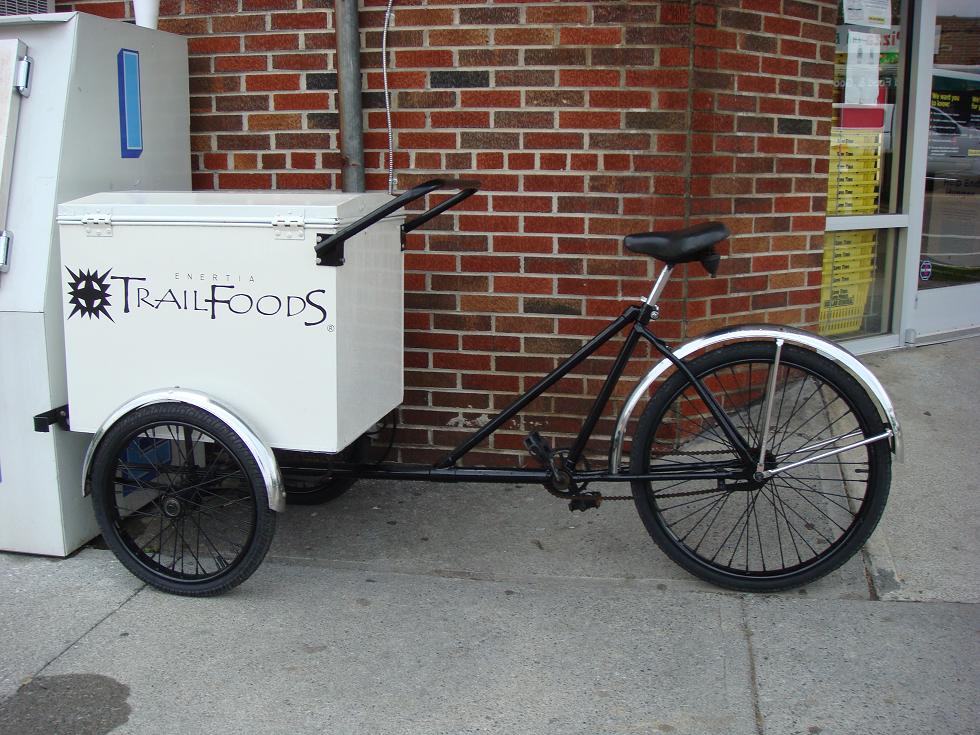
Hyperlite Mountain Gear and my wife ended up getting a t-shirt, no doubt targeting young females to advertise for them was probably a smart business decision. Probably the least unexpected was the freebie I got while standing outside the Dollar Store as my wife found new and innovative ways to burn my hard earned money. Essentially, as I was loitering outside the store, a guy came up pedaling a three-wheeled old school delivery bike. He asked if I'd watch his bike and make sure it didn't get stolen. I said sure and he marched off into the store, but not before telling me not to steal it. About 5 minutes later, he and my wife walked out of the store nearly in tandem. He introduced himself as the owner of
Enertia Trail Foods. He reached into his delivery cart and pulled out a single bag of food, tossed it my way, and headed off. Little did I know the single bag contained four meals from his company. I was pretty happy, although I told him several times it was unnecessary. He reminded me of the same thing I argue all the time about the contents of my backpack, and that was his delivery cart was lighter without it. Can't argue with that.

I spoke to a lot of vendors, more than normal, and enjoyed learning about new products, seeing innovation, being able to meet the people behind some of the products I enjoy most, and watching this industry continue to push into new and exciting directions.

I spoke the three food vendors worth mentioning here. First, The Pasta Wench (
http://www.thepastawench.com/) is a small business which sells, no surprise here folks, pasta. She lives on a farm in North Carolina and creates organic pasta with unique flavors integrated into the pasta itself which I thought was pleasantly unique. The product is fantastic. Next was Primal Strips Meatless Vegan Jerky (
http://www.primalspiritfoods.com/). As the name implies, this vendor sells no-meat jerky. I've seen it in more natural stores like Whole Foods, but never tried it because, well, the packaging made the product look wet and a little unappetizing. Being willing to try something new, I tried a couple different flavors and I must say it was truly fantastic. With more protein than meat and a healthier option overall, I will have no problem making this product part of my backpacking kit. Last, I spoke to the people at Outdoor Herbivore (
http://outdoorherbivore.com/about/) and found several intriguing products. They focus mostly on vegan options, but have vegetarian dishes too. My intent on mentioning these three vendors is not because I'm vegan/vegetarian, because I'm not, but because they were new to me and offered some extremely tasty food. As a diabetic, I must be very careful of my diet and quite honestly my doctor has long suggested that I give
veganism a try. When looking at the hard science of it all, it's pretty convincing. Unfortunately, as an American, animal products are part of my cultural diet, and well, I find them to be tasty. Yet - my health has, and continues to, suffer to a certain extent from this diet that works well for some and yet others like me are more greatly impacted. So with that, I'm a vegan some days and others - not so much.

One item of particular interest which I've been expecting to come to market for the last two years was the
nPowerPeg (
http://www.npowerpeg.com/). For those of you that use electronic gadgets on the trail, this product allows you to generate your own electricity through movement of the device and forgoes the need for solar options. It can also gain energy from plugging it in. I suspect this will get a lot of press in the near future as many have been waiting for it to come to market.

If you haven't heard of a hiker named
Skywalker, you probably haven't read his book either, "
Skywalker: Close Encounters of the Appalachian Trail", by Bill Walker. Perhaps singularly because I'm 6'5" and gripe a bit when things are too small for me, Bill has me easily beat at 6'11" and I was intrigued to get his input on the topic. I read his Appalachian Trail book and thought it was very well written, quite humorous, and covered the challenges of being extremely tall quite well while intertwining it into the social aspects of the trail. He seemed very much like the average guy and I appreciated his mastery of language in a manner usually inconsistent with others who pen details of their backpacking journey's. I'm not a big reader, although I've found myself reading more and more as I get older principally to combat that which I sense to be my abundance of growing ignorance, and I honestly read his book completely in two evenings because it was just easy and intriguing enough to capture of imagination for the long term. To my surprise, his hiking endeavors didn't end with the Appalachian Trail and instead he decided to recently hike the Pacific Crest Trail (PCT) which he captured in his new book, "
Skywalker - Highs and Lows of the Pacific Crest Trail". Having not read it yet, I look forward to once again rejoining him (in spirit) on another hike, one which apparently took his toll as he jokingly said he wouldn't do it again and apparently didn't seem overly enthused about potentially going for the Triple Crown.

I spoke to Mark
Flagler with
Flagler Films (
http://www.flaglerfilms.com/) several times over the course of two days. I kept bumping into him and we found common ground to chat about one thing or another. In as much as
Skywalker was interested in passing along his self-demeaning humor and relating to anyone willing to talk to him, I found Mark to be extremely easy to talk with and tremendously friendly. He's one of those guys you meet for a few minutes and realize he'd be a great hiking partner and someone who wouldn't rock the boat at camp. I've know of Mark for several years through his films such as, "Appalachian Impressions" and more recently "Walking the Great Divide". The films are very G-rated and move along at a pace that won't give anyone a heart attack, but cover backpacking and hiking topics which I find enjoyable and quite honestly have very little competition. Although I'll probably chug a little bit of caffeine for his next film, I will indeed watch it.

I also spoke with Mike St. Pierre, the founder and CEO of
Hyperlite Mountain Gear (
http://www.hyperlitemountaingear/). They've been getting a lot of press lately, despite being a business for only about 18 months. My initial thought on both Mike, the business, and his products was - impressed. I can't think of another "new" cottage vendor who jumped into the market with such a great business plan and top-end, well thought out products. This isn't a guy who decided to jump into the backpacking industry without clearly a lot of thought and

solid product development. From what I saw, there wasn't a single item in his area that I didn't want sitting in my gear closet. I had read a lot about his Echo shelter system previously and quite honestly I thought it consisted of too many parts to get a functional system together. Granted, the intent was to give the user options to use the system singularly as a tarp, a net tent, or two together, and then a rain fly/vestibule of sorts as needed. When seeing the items all put together, my first thought was how well they were made, how spacious the shelter was, and how everything seamlessly fit together with such conscientious engineering. Although I still think it is a bit fussy to set up, it is likely no more or less dramatic than other dynamic and highly functional shelters. I echo the same sentiment for his
Windrider packs. Well made, classy, and quite honestly, at a fairly realistic price-point considering the materials used. What those who don't handle his packs likely don't appreciate is the robust nature of the material he uses. He is using an extremely heavy-duty
cuben fabric, the likes of which I have never seen. I own a Z-pack and it pales in comparison in both fabric durability and engineering. Where I look at my Z-pack as more of a novelty item and one which I use for short stints and don't expect to last for a long time, the
Windrider is something I can honestly see easily competing with other fabric options in long term packs, but doing so with a far lesser weight penalty and highly functional options. If there was a vendor at Trail Days this year who impressed me,
Hyperlite Mountain Gear was it. Time to start saving some money. Disclaimer: To be fair to Z-packs, I should mention Joe
Valesco, the owner, hiked the PCT and CDT using one of his packs (one for each hike). So, my implication that it wouldn't last doesn't hold a lot of water when in the right hands. Course, Joe is also arguably a unique backpacker in his own right.
I stopped by Mountain Laurel Designs (
http://www.mountainlaureldesigns.com/) to see what Ron was offering to the masses. He brought a couple backpacks, some
mid's, and the new Cricket shelter. Ron makes excellent stuff. We chatted briefly about lengthening the shoulder straps on his backpacks when he does a custom tall because
MLD often uses standard straps which leaves no room for adjustments when used by someone with a longer than average torso. We also talked a bit about the Cricket. Personally, the Cricket wasn't for me as I thought it was sized a bit small for even the average person and felt it really didn't offer too much to an industry with many similar offerings. It was also a pain to get in. Generally speaking, I don't like shelters that require me to get on all fours to get in. No doubt, however, it will find a solid following if for no other reason than the excellent manufacturing and and logo on the side.
Without reliving every blow-by-blow moment of Trail Days, I did want to point out some observations which included one of the principal reasons I visited this year - to compare the
Skyscape by Six Moon Designs (
http://www.sixmoondesigns.com/) and the
SoLong 6 by
Lightheart Gear (
http://www.lightheartgear.com/). I understand these shelters are on the radar of many and I've come to the conclusion that merely reading spec sheets does not adequately compare these two shelters. In fact, I would argue that these shelters are quite different with noticeably different features that may be more desirable to some and less to others. Equally noteworthy is the fact that these shelters are geared towards taller people, or perhaps more politically fair, people who wish to have more room at their head/feet. Since I fall under at least one of those categories, let me publicly say
THANKS!

First off, to be fair, I spoke at length to both Ron Moak (SMD) and Judy Gross and Marc Penansky (Lightheart Gear). In fact, I probably spent more time with both vendors than anyone else at Trails Days this year. As a general summary statement, I think what you get with both manufacturers are people that legitimately care about bringing solid products to market. I think both offer competent engineering/manufacturing and both do listen quite intently to industry criticism or customer concerns to drive their products. SMD has been around longer and is a bit of a veteran when it comes to both backpacking and the backpacking industry, but make no mistake, Lightheart Gear is more than happy to shake the tree, seek constant improvement, and think outside the box. Bottom line - good for you and me.

Directly comparing the Skyscape to the SoLong 6 yields significant differences even though they bear a striking resemblance. The Skyscape comes in three versions to enable the customer to essentially pick one of three fabric options which directly impacts the weight and cost. The SoLong 6 can be made in silnylon or cuben, and because Lightheart Geart is a custom shop to a certain degree, the customer can get wildly creative on the number of entrances, zippers, hardware used, and also the color. Lightheart Gear offers customers the wonderful opportunity to select one of approximately 20 color offerings if the fabric of choice is sylnylon. For anyone who has spent a lengthy amount of time in a tent, at least in my opinion anyway, tent color greatly impacts attitude. To me, the amount of light that comes in a shelter and whether the color is bright and cheery or drab and dreary falls into the same line of thinking as Seasonal Affect Disorder suffered by some in winter climates where the sun isn't as readily available and the greenery/color is otherwise lacking. In as much as I like being unnoticed in the wilderness, I fully appreciate and welcome brightly colored shelter roof options for this reason. Course, for those of you in bear country - BE CAREFUL with bright colors on anything (shelters, jackets, hats, etc.) as some studies indicate bears are more interested in bright colors than others.

Size-wise, the SoLong 6 is a far roomier shelter in every noticeable aspect. It is clearly wider, by quite a bit, taller and wider at the peak, and has more usable length space principally gained by four carbon struts at the corners. Even if the SoLong 6 and Skyscape were exactly the same dimensions, the struts offer lift from what would otherwise be a roof resting on the face and feet of taller hikers for very little weight penalty. The SoLong also helps itself by being boxed off at both the head and foot which allows greater use of the available space whereas at some point shelters that come to an apex are generally only useful for gear storage. At 6'5" when laying down in both, and factoring in a sleeping pad and sleeping bag/quilt, I have no doubt that the roof of the Skyscape would have either been on my face, feet, or both. I do not suspect this will be a problem with the SoLong 6 because of the struts. When sitting upright, the roof of the Skyscape was on my head while I had a few inches in the SoLong 6. So the question is, for your personal needs, do you need the additional space and/or the additional width? To me, I feel I need the length and this is a conclusion dominated by my height alone. The additional width is helpful, but not completely necessary in my case. However, a tall shelter with a floor dimension that isn't as wide would no doubt be a little more subject to wind challenges. Bottom line - if you want a shelter with this vertical height and length, it needs to be wide to a certain degree to remain upright and stable.
Another detail that I was fairly surprised to see such a difference was in the bathtub floor boasted by both. On the SoLong 6, no doubt it was there and seemed taught and very functional. On the Skyscape, I had to look several times because I was convinced it was laying flat. As someone who has both been under tarps and tents in pouring rain and had the thrill of a near river of water washing under the shelter, if the manufacturer claims to offer a bathtub floor I would hope it would be pretty evident even if not set up with all corners stretching to the extreme just to get it upright.

If you need more space, or if you are of the taller persuasion, the SoLong 6 would probably be your better option. To be fair, the SoLong 6 costs more, but to be equally fair, you're getting more in the sense of overall size which means more costly fabric and time to make it. I'm guessing there will be a real competition between these two manufacturers concerning price. The fact that these shelters are so similar, to an uninformed customer focused only on a spec sheet may elect to purchase the less expensive shelter without understanding the significant differences in space. It would be an interesting study to see which tent prevailed in the eyes of the consumer if both tents were priced the same. For now, the entry-level Skyscape with 190 T canopy/floor at 34 oz and on sale for $90 is truly a wonderful option for quasi-ounce counters who want a legitimate lightweight tent, with room, at a very reasonable price. I should mention of the three options and pricing for the Skyscape, two of them are on sale now which means pricing will be more competative towards summer. The silnylon version of the SoLong 6 at 26 ounces and $275 isn't unreasonable either. The equalivant of the Skyscape for similar materials will be $225 towards the summer.

If you are an ounce counter, the cuben Skyscape rings in at 16oz. This is no accident from a marketing standpoint because a one-pound shelter will no doubt get a lot of buzz. Merely using cuben will cut a lot of weight to reach this goal, but my fear is that this will start a trend of using the lightest cuben merely to gain a particular weight. This sounds great when written on a box, but in the end the greater question is whether these super ultralight shelters will stand-up to long-term trail use which is somewhat implied for the price range. The demo cuben version of the SoLong 6 made for Trail Days came in at 21 oz. It could be made lighter, although reaching 16 ounces would be a stretch and sacrifice some durability. Judy and Marc are considering different weights for the canopy and floor, so it will likely get lighter by around 2 ounces before fall 2011.
Comparing the demo cuben SoLong 6 to the next shelter I have at nearly the same weight, the Tarp Tent Contrail at 24 oz, the reality is that the SoLong 6 has vastly more room and function and comparing these shelters isn't really fair. If they were the same weight, I'd take the SoLong 6 any day of the week. Consequently, the silnylon version of the SoLong 6 at 26/27 ounces really is quite a reasonable weight and will save many users a ton of money that would otherwise be spent on a cuben version that may not be as needed. Although a 16 oz shelter is a wonderful concept, in the end, my question as a consumer is whether every possible corner was cut merely to gain the most impressive marketing gain. After all, a shelter made of tissue paper would be very light, but offers little long-term protection. If I'm dropping +/- $500, the shelter needs to last and strike a balance between weight, cost, size, and durability. Other consumers with deeper pockets or distance racers would perhaps argue otherwise.

One feature of both shelters that I found to be interesting and warranted quite a bit of conversation from both was what was used at the peak to give the roof some dimension and width and hooks to the ends of hiking poles to provide lateral stability. SMD used a piece of carbon wrapped in some plastic-like fabric that I've seen on tie-out areas of SMD shelters. The fabric is very durable and ridged, but the support had quite a bit of flex to it and ultimately all the energy would be focused down to the single thin carbon rod, about the diameter of a pencil. I'm sure it would work fine for most reasonable 3-season uses, but I wouldn't feel terribily confident with it holding any kind of snow load or in heavy winds which perhaps isn't the intention anyway. In this case, the width of the floor would play a significant role because the wider it is the more stable it would be. I may be reaching a bit on this evaluation, but I felt this was one of those ways that cutting weight might also be cutting stability and function. The Skyscape roof structure isn't as wide as the SoLong 6, and thereby the ground width isn't as wide either. Consequently, it also isn't as tall. The SoLong 6 on the other hand uses a piece of extremely lightweight piping conduit (specific industry name unrecalled). I was corrected when I called it PVC which was used on earlier versions of Lightheart Gear tents, and to be honest, I was impressed with it. It is a very simple, one piece components bent to size which appears to be extremely strong, lightweight, and durable for the long term. I would say it was about the diameter of my pinky, but was far more robust than the SMD offering and much lighter than standard PVC pipe. I had no problem with it and found it superior to what SMD was using.
Not to degrade either manufacturer as ultimately it comes down to the needs of the consumer. Both are great shelters and nothing lesser should be taken from my review. I would be happy to own either, but felt more comfortable in the SoLong 6 despite the difference in cost and additional 6 ounces in weight. This is a decision weighted heavily on the fact that I'm taller than the average person whereas shorter people might be able to make due with other design elements and may not mind the fact that it is made for a little more controlled conditions.

It has been my experience with Trail Days that the weather is either hot, humid, rainy, or a combination of each. This year proved no different. As the rain drops started to fall, my wife and I headed for the car and to our 5 hour ride home. On the way after creaping along at elevation in some heavy downpours and smothering fog, we stopped at one of our favorite strawberry picking places and witnessed the young crop of peaches and cherries coming in. Driving through the mountains, enjoying Trail Days, and reminising about why I truly enjoy Virginia so

much made this another backpacking-related outing that won't easily fade away.
And yes, I'll be returning very shortly to collect those peaches.
 Although not necessarily true in every situation, the world of lightweight backpacking is often fairly expensive. Most vendors referenced in my blog are known for solid products, but also for being fairly pricey (often justifiably so based singularly on materials). Is there anyone out there who offers good stuff at reasonable prices?
 Another vendor recently offering lightweight cuben tarps is Lawson Equipment (http://www.lawsonequipment.com/). Currently there is a sale offering "any" of his cuben tarps for $225 plus free shipping which is really a nice price point, albeit an introductory offer.